Saturday, 17 August 2013

Polytunnel Island


Its all very well planting courgettes under old bed frames pulled from skips and covered in plastic, but the only way to 'grow your own' properly on Lewis is to get a polytunnel.

We had re-dug the large ditches running either side of a flat section of croft by the house and named it Polytunnel Island. It took a while but eventually we bought the required piece of equipment to complete the name.

Our tunnel is 6m x 3m, and it was cheap!  I hereby give in to the idea, perhaps fact, that it will not last in the Hebridean environment, but we did so much research for so long and talked to so many people about which was the best tunnel to buy that we
a) never got round to buying it, and
b) couldn't afford the one that looked the best - despite the hope that we could get a grant to cover some of the cost.
But this year we are following the Nikey mantra 'Just Do It', so we are.

The polystyrene boxes came from a local fish farm - they were brand new packaging cases, but someone in marketing noticed they needed to change the name on the box.  They say 'Wild Scottish Salmon', but should have read 'Farmed in Wild Scotland', two very different things and something which would warrant a whole other blog post on fish farming...

...but anyway, I had to drive the van to Scalpay to pick the boxes up.  The fish-farm had a warehouse full of them and had contacted the Lewis & Harris Horticultural Producers group to see if any of their members could put them to good use.  Perfect, we thought, but unfortunately the logistic of picking them up from Harris proved too much for most growers and the majority of the boxes ended up in landfill.  Such a shame when needless waste occurs despite the best intentions.

As the year has continued though, they have been just the thing for our softer crops and seedlings.

Baby courgettes, picked young and roasted whole


Mixed lettuce leaves

Tomatoes
Oregano at the back, guerkin at the front
Meanwhile outside things have grabbed a couple of months of hot weather too. Beetroot, turnip, swede, rhubarb, red onions, rooster potatoes, cabbage and broad beans have all done well. Sometimes they have had a boost from an old bed frame cloche, but some have been given special treatment in our newest vegetable patch, carved out of the marsh grass last year with a digger.

Potatoes in the new bed - purpose built cloches in the background, made by Mark - they seem incredibly superior after my tatty bits of plastic on bed frames!
The beloved and faithful courgettes, 3 different varieties this year

and of course theres always eggs from our lovely hens... when they're not going broody and putting their sisters off laying...

One day, perhaps we will make it to our dream of having a Pick-Your-Own-Vegetables-and-More shop.

Customers will come and pick their own food from the ground so it is always fresh (home grown veg goes off noticeably quicker than shop bought because there are no chemical sprays on home produce...)

In the same way that at the moment my customers wander in and ask for eggs, I hope they could come in and wander around the vegetable patches, choosing what's ready and in season.

It's a way off yet, too many hurdles to straddle in learning what grows well in our Hebridean conditions.  But by getting the polytunnel on polytunnel island this year, I feel we are a step closer....


Sunday, 11 August 2013

Last words

There's never a right time to say this, but I don't want it to get missed just because I never wrote it down. In fact its creepy writing it now, like I'm tempting fate to play its worst card.
However.
When I die, I would like the following as my epitaph:

Do not cry for me, I am not gone,
I am the wind on the grass and the corn.

Saturday, 10 August 2013

Returning to work


A time has arrived, which I knew would come some day and I have always dreaded it. The end of my maternity leave.

I can't complain with the amount of time off I've been allowed - just under 9 years in all.  Obviously this has not been granted by one employer, but has been made possible by a sketchy combination of employer contributions, a generous tax credit allocation and various overdrafts, not to mention downscaling from our house in Coventry in the midlands of England and moving to the remote Isle of Lewis off the NW coast of Scotland.

But it is a time which has allowed both me and Mark to enjoy raising our wonderful boys and to see every stage of their development and safe entry into the school system... plus a couple of years just for good measure!

Looking back on what I felt was a turbulent time working, I can now see how decent people at my old work place did everything they could to wave goodbye in the kindest way.


I had been working for the Learning and Skills Council for 7 years and at the same time as applying for maternity leave, I was also applying for voluntary redundancy. I was given both, and 2 weeks before my due date, I waddled away with some lovely leaving presents for the baby and enough money to set us up for a whole year.  I couldn't have been more pleased to be leaving.  Regardless of the happy circumstances of having my first child, I had not enjoyed being a very small cog in a very large machine and had grown very bitter and insular despite outward appearances.

So naturally I had dreaded returning to the professional open plan office environment, with no soul and no love allowed, where decisions were purely business and people are forced to be schizophrenic, splitting their personalities between work and home.

However, things are different now. I am different. We are in a different world on the Isle of Lewis and I do not have to go back to where I was before.  I have been given a job which just ticks so many boxes for me, that I am still a bit scared to believe it is true.

I cant escape the nature of the work - administration; all the boring and arduous details that bog people down, but have to be done - the devil is in the detail. 

But it is for a small company - I will be able to feel the effect of my work and see the results directly.

It is local - I don't have to spend money on a car and petrol to get there and I don't have to spend time travelling.  I can walk there in half an hour or get the bus in 5 minutes.

It is informal - I do not have to struggle into tights and stupid shoes every morning and freeze my toes off in an air conditioned fashion parade.  I can wear jeans and boots if I like because nobody cares what I look like.


The boss is female - I am working for a mother of three, a friend and neighbour and I am already behind her and her business and everything that she wants to achieve. I can see her visions and understand the processes she needs to go through to realise her ambitions.  It is not something that I would do myself, but I know how to support someone else and I'm looking forward to being able to use my skills to help grow her business.


So here I go, an employee again and I never thought I would be this relieved to be returning to work.

Sunday, 28 July 2013

Everyday tesselation


Ever since I've had children and my life has become my own to control, I have found that things often resemble one of those sliding tesselation puzzles. You know the ones, that have a grid of squares and you must move the pieces around until they at last make a picture. 
Its a bit like that, organising different parts of everyday life, moving the pieces around and around until suddenly - it fits! The bigger picture can be seen.

Todays example involved cooking sunday lunch: I'm peeling turnips and wondering how I am going to manage to store all the turnips we've grown so that they don't go off, because in time we want to keep pigs again and turnips are a great feed for them.  The only practical way I have found to store them so far is in soups - not so good for pigs, but fine for humans.

This year, because of the current lack of feed for pigs, we have taken on 4 orphan lambs instead.   We have bottle fed them since they arrived, with cows milk and they have done very well.  We asked the shop accross the road whether, rather than throw away the bottles of milk that had got to the day of expiry, we could take them off their hands.  Fantastically this meant we gradually built up a chest freezer full of milk to then feed the lambs with once they arrived in the springtime. 

The shop has stopped wasting its unsold milk - piece 1 slides...
The milk has been drunk by the lambs and saved us from buying in formula - another piece slides..
I'm left with a mountain of plastic bottles....no picture apparent yet ..
We start harvesting vegetables and soup-ing what we cant eat fresh...another piece of the picture slides...
I use the plastic bottles to store the soup and the final piece in the grid slides into place.

The tesselation happens by moving the given pieces around and around until they all fit to form an organised picture, with no gaps and no overlaps.

Ok, so its a pretty obscure example - what do you expect, peeling turnips is not the most inspiring time you can have.  But it did remind me of other times, of juggling children, people, events, money - when suddenly the disparate pieces have slid into place and a glimpse of an ordered, cohesive bigger picture has been acheieved.

I'm sure a mathematician could explain this all much better - there is probably a nifty algorhithm or formula that saves all the waffle about turnips.

But in my head I can see some order from seemingly separate events.... so thats reassuring...


Wednesday, 24 April 2013

Growing Your Own


It has been 6 years since we moved from Coventry to begin what we hoped would be a self-sufficient life.  We wanted to buy a house outright and not pay a mortgage.  Pay off our overdrafts and live within our means. Well.... old habits die hard.  But we have stuck to our dream of growing our own food.... it doesn't last all year, it takes time of course, but it does supplement the supermarket shop and there are weekends when we are very nearly self sufficient (damn those chocolate cravings...)

When I was little my Dad subscribed to a weekly magazine called 'Grow Your Own'.  He collected each issue in a 1970's brown binder and built 2 polytunnels in the garden.  That summer, I was introduced to a new world, an alternate climate with the strong smell of tomato leaves and courgette plants like something from 'Invasion of the Body Snatchers'.  The atmosphere in that tunnel still comes back to me regularly in dreams, I'm not sure what significance it has but its had a lasting effect.
Since then I have always wanted to get a polytunnel - finally, 6 years after moving to our own home, we have got one!
Inside the polytunnel
Apart from my Dad's magazines my past experience of 'growing my own' was in our garden and greenhouse in Coventry and later on our alotment (which also features often in my dreams - for some reason I keep going back there years later to see what still might be growing...)
The garden path in Coventry, tulips on the left, leeks on the right.
The alotment was an invaluable place to learn hands on, thanks to all the retired people who now worked full time on their plots. I must have been listening because the first harvest from the alotment was abundant and delicious.


Growing in the Outer Hebrides however is quite a different game. There are a number of additional pests that we encountered which weren't native to the Midlands, first and foremost sheep, then cows and by my own doing, chickens. The chickens were our own to take responsibility for, but the cows and sheep were from next door and harder to come to terms with.

The first thing we put in, back in 2009, was our 'poo bed'.  I had been reading a book on permaculture - a way of growing where the idea is to work alongside nature; rather than trying to constantly tame and shape it, you can put in less effort by going with nature's flow.

I shuttered off a large section of  ground in the old hay drying area on the croft - it has 3ft walls and provides some good shelter from the worst of the gales.

Then I lined the base of the raised beds with old newspapers, wheelbarrowed over from the shop accross the road.  The idea is that instead of digging over a matted grassy area, you put a layer of weed retardent down first, then fill it with dung and plant potatoes into plugs of soil that sit within the manure. The you cover the whole thing in either more soil, or in my case, bags and bags of grass clippings dropped off by a local garden maintenance firm.

The result is odd looking but it saves a lot of digging.

Potatoes growing through the grass clippings mulch

 It worked very well indeed. the mulch retains the moisture which potatoes need a lot of.

When the plants have flowered its supposed to be the right time to dig them up.

You don't need to turn the soil over completely once you've got all the potatoes out, because it will all rot down, and the paper will biodegrade to make a good nutrient rich patch again next year.

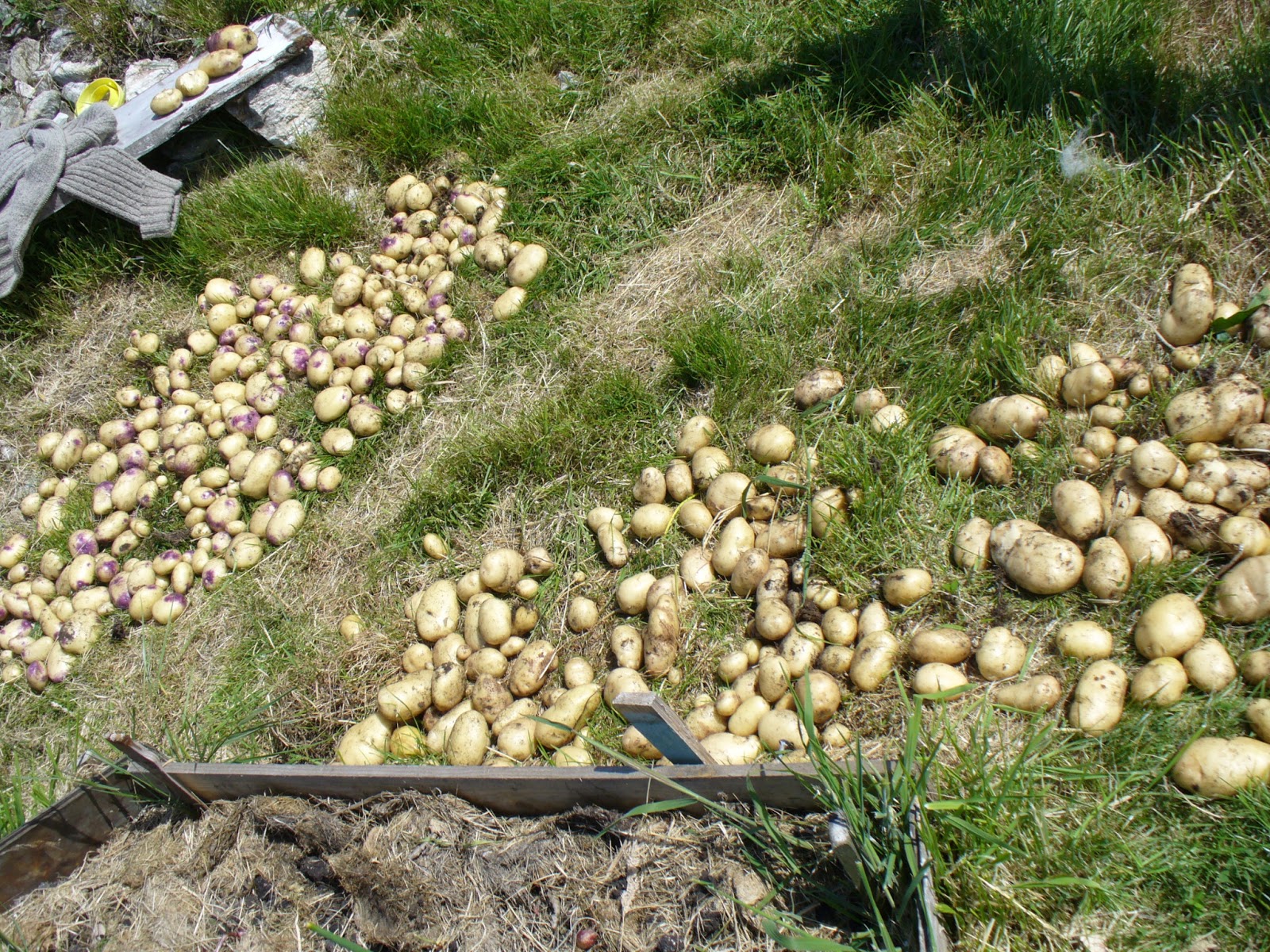
It is such a wonderful feeling digging up potatoes, like funding golden nuggets.

Laying the potatoes out in the sun to dry

The potatoes nearly didn't happen at all though, due to an infestation of cows at an early stage.  I had set up the raised bed, planted the potatoes and covered it all in grass clippings. I had put together a fence from, here's the error, old fence wire and posts and the smell of silage wafting accross to next doors field must have been too much for the old dears.  As soon as I popped inside for a well earned cup of tea, they nipped through the gap between us and next door and were in like a shot.  They walked through my fence as if it wasn't there and I returned to the patch 20 minutes later to see them chomping down a large mouthful of grass clippings and seed potatoes each.
There is a reason we have gun laws in this country, that afternoon I nearly made a whole lot of beef burgers. 

The next day Mark put up a proper fence for me.


 After the initial teething trouble, the poo bed worked well for other crops too.
Courgettes and onions did well with its rich mulch protection.


Just as things were growing well we fell victim to the next infestation.  I had planted runner beans, sweetcorn and strawberries in beds surrounding the poo bed.  When I found next doors sheep in there one day, the air turned blue.  It looked as though someone had been at everything with a strimmer. They had completely mascerated the sweetcorn and just left the stalks

Sheep damage, note they left the rhubarb alone, the leaves are poisonous to them - shame
I had been so looking forward to runner beans, simply boiled and covered in real butter.  The sheep beat me to it.
Runner has beans
In Coventry the men at the alotment built huge runner bean walls, like something from the world war trenches.  There was such a glut of them every year you grew tired of them.... until one day you just can't grow them.


To be honest, while we still managed to get a harvest from some things, that year was a huge knock to our confidence of growing.  We had hoped we could get straight into the soil before tackling the larger, harder problems of fencing on the croft. We had learned the hard way that sheep are evil, they can jump old fences and the only way to help yourself is to barricade with barbed wire and 6ft posts!

Fencing, you can't have enough of it

After that we stuck to growing outdoors, but under cover.  the community skips prove to be a valuable resource for anyone used to an alotment style of growing, where any old bit of tat can be put to good use.

Old bed frames proved to be the most effective. Especially when they were thrown away next to the packaging plastic that the new bed's mattress came in!  We have quite a few of them after regularly keeping an eye on the community skip, they are great for courgettes.

Pallets also prove to be effective sheep protection.  This potato box had netting over the top to keep the chickens off, then when it came to harvest time you just pull down the walls and the potatoes fall out. It doesnt look pretty I know, but I do functional gardening, I'm not bothered about aesthetic!


 In 2012 I did more potatoes in the pallet pen and for the first time broad beans.  They benefit from the shelter of the pallet walls, but still get enough sunshine to grow.


Turnips under a bed frame cloche
At last we had done enough fencing to <mostly> keep the sheep out.  It has taken a lot of swearing and realisation that sheep will wait until you have grown something before they show you where your weaknesses are. But finally we have started to get our harvests back up to an alotment level.


2013 is the year of the Polytunnel though....we are hoping for great things.....


Thursday, 28 March 2013

Life on 2 legs

Writing something about not having a car, is a little daunting knowing that there are 2 groups of audience - those with a car and those without a car.  The likelihood is that, if you have never learned to drive, the following article will be blatantly obvious and possibly a little crazy sounding. But if on the other hand you have once had a car, it is likely that you will always have continued to have a car.  Once you've had the liberty of your own transport, you rarely go back.
Once upon a time, my brand new car - only 16 miles on the clock

From 2012, what the Mayan's forecast as the end of the world, I found myself at the end of the world as I had known it.  All our vehicles (and we had certainly got through a few) had given up the ghost, we had no money for another one and were left with no other option than the bus. Not only this, but an infrequent bus service which only goes in the town direction once in the morning and once in the afternoon, and vive-versa.  Not to mention the times when you need to go in a different direction at a different route to the bus - it was going to be tricky.

Mark's 1st landy - all purpose vehicle
The obvious bonuses of not being mobile were purely financial.  First I noticed the monthly direct debit for insurance disappeared, leaving me £40 a month better off - well, that really adds to the supermarket budget.
Next it was the lack of impending doom every 6 months when the road tax was due - our car tax always seemed due the month before Christmas - suddenly I could buy a few presents earlier and felt a lot more organised and in control of the big event.
And then of course there was the annual crisis of the MOT.  That unknown figure that lay lurking ahead, was it just windscreen wipers, or was it welding....

I really felt a huge weight off my shoulders when the monetary obligations were removed.

Mark's 2nd landy - fun, except for the repairs bill
So of course that meant I was now relying on the bus - it doesn't sound so bad? Surely?

But;

1) I get travel sick.
The way the buses on Lewis work, we have a small mini-bus with about 12 seats that runs around to all the villages in south lochs, and then connects with a coach on the main spinal route through the island.  I have many bad memories of these 1970s style coaches, with that strange smell of upholstery and the way they bounce around if you sit at the back.  I won't mention a long school trip from Essex to North Wales which pretty much sealed the travel sickness bug in me for life, but the coach hurdle was the first thing to overcome.
The main route bus from Leverburgh, Harris to Stornoway, Lewis

2) Other people are not always nice.
As well as the financially car-less, the bus also caters for people who cannot drive for other reasons - such as they are drunk. There is nothing that you can say to take away the unpleasant and lewd behaviour of a fully grown man who should know better and probably might when sober, but for now is sat in a tight space with you. Enough said <shudder>. 

3) You have to carry all your shopping around with you.
Thankfully our local supermarket operates a 'you shop we'll drop' service, whereby you can fill your trolley and they will deliver it all home for you the  next morning.  However, there are always other things you want to buy whilst in the consumer capital, and unless you have rock climbing arms and fingers, carrying the bags is an unfortunate downside to just throwing everything in the boot of the car.  

However, having outlined the worst case scenarios I can also include the following.

Bus travel is preferable to car travel because:

1) You get to meet new people.
Apart from the stinky alcoholics, bus travellers also include friendly old people.  The best way to get over any windey-road travel sickness is to have a nice chat with someone who has lived a long and full life.  After a while you get to know how to pick your seat to make the journey much more bearable.
The Stornoway to Tarbert coach passing through Aline

2) You're saving the planet.
You no longer need to feel guilty about adding to rising CO2 levels as you speed your lonely way into town.  It is far more cost effective and environmentally friendly to fill one vehicle with 20 people, than to put 1 person in 1 vehicle. No brainer.

3) You hear all the latest gossip.
Even if you're not talking to anyone, bus seats are near enough to each other to garner all the local news from your fellow travellers. Its a bit like putting your status updates on as 'Public'.

4) People get to know you too.
In a small and well established community, new comers to the bus stop are often viewed with great interest. When you whizz through the village in your car, people can only speculate.  Once you're one of the crowd, people find out exactly what you are like, and even forgive your travel sickness rudeness on occasion too. 

5) Its cheaper.
If its just you, the bus is far cheaper than a round trip in the car.  There is a lot of freedom to be had by saving money. A mark of a civilised society is one where its citizens chose to travel by public transport, not because they can't afford a car..
Small Harris bus and view

6) A bus journey is the perfect place to daydream.
As a car owner you are always the driver and rarely the passenger.  There is such a fabulous time to be had gazing out of the window of a warm bus at the beautiful scenery of Lewis.  I have solved the problems of the world while my mind is rocked soothingly.  If you step on the bus with the right attitude, it will take you to new places.

So I'm not saying I will never own a car again, but I feel I have spent too much of my life worrying about and spending money on a lump of old metal.
A car has given me freedom, but a ball and chain at the same time.

Nowadays, if Ken Kesey was to ask, I am definitely on the bus. 

Ken Kesey's bus


Sunday, 3 February 2013

Piiigs Iiin Spaaaace...

"Piiigs Iiin Spaaaace..."

It was the springtime of 2009 when we saw a card on the notice board of the Crofters: "Gloucester Old Spot X piglets, £45 each. Ring 880123" We had been dreaming for a while of getting something a little more involving than the chickens and decided that now was the time.
When we spoke to the owners, it turned out they were family of our neighbour - as if often the way on the island. He only had 2 piglets left, one of them was the runt of the litter, but if we didn't mind growing a slightly smaller pig he would let us have them both for £60.  Of course we didn't mind, this must be the nicest bargain we'd ever had!

Mark went get them in the van. He penned off an area in the back to keep them contained and 5 minutes after collection, was happy to have one of the piglets join him on the drivers seat.  The pen was not quite up to it and he spent the rest of the journey home trying to remove one or other of the piglets from his lap, under his seat, or down by the pedals.  Figuring by now that they were pretty wriggly squirmy little creatures, he realised why the crofter he'd collected them from, brought them out to his van in a large bucket.

Knowing the perfect instrument for the job, as soon as he was home he contained them at last in a broken water butt we had rescued from the community skip.

Ying & Yang piglets


 Austin and Morris had helped get a small area in the old blackhouse ready for them the previous day.  With a cozy depth of straw and the familairity of their bucket, we moved them in and were able to get a proper look at them.

Gloucester old spot cross piglets
  A sister and brother team, she was the bigger but it took a while to tell the difference between them.  We set up a viewing gallery and the eager audience moved in.


Pig installation

First activity, feeding time.  For some reason we hadn't yet bought any bags of pig nuts, so made a hearty porridge of scraps as this is what they'd been used to in their old home.  With a little coaxing of 'here piggy piggy..'


Here piggy piggy...


We were relieved to see that after their first meal in a new home, they managed to let their bellies rule their heads and settled down for a little nap.  Just like with a new baby, it was hard not to keep bothering them or waking them up again just to remind ourselves of how cute they were.  But we managed to tear ourselves away...for just a little while.

Over the next week or so we all had a lot of fun getting to know each other.
But there was work to be done. They wouldn't want to stay in their small home for very long so Mark and his Dad got to work on reconstructing an old sheep enclosure at the back of the blackhouse.
We made a partition wall and put down an insulating layer of polystyrene under a concrete floor.  There was a small drain at one corner to let any water run out.  It seemed sturdy enough for 2 pigs, no matter how large they would get, but as we discovered later on, they got very interested in the little drainage hole in the corner. I think they could smell air through it, and what started out to be a little bit of snout-ey investigating, soon turned into them eating large sections of the floor, polystyrene and all.  I had noticed that there were little white balls in their field and had assumed it to be something that was put in their feed.  Then when I realised they were eating the floor, it dawned on me that it was polystyrene balls, coming through their digestive systems completely in tact!
We made a roof from pallets, a freely available resource on the island as everything arrives on a pallet. There are plenty of haulagers in town who let people take them away for free, it is endless and welcome and only costs you in petrol to collect them.
Mark used off cuts of pallets to make a doorway and suddenly the place was looking more like a holiday cabin than a pig shed.
After securing their outdoor area, we sent the boys in to 'plump up the cushions; of this special piggy den.
Yep super cozy. Just as well because the piglets knew something was going on..
Let us out!
At last it was back in the bucket for them - they'd already grown enough that only one was allowed in at a time so the sheer joy of being in a bigger space was obvious with all their little skippety jumps and spins.  Mostly however, they once again settled into their new home by filling their bellies and taking a nap :@P